
Digital diet
Screen time is challenging balance for many kids and families. In this resource, we offer strategies to help parents navigate setting limits for screen time and measuring quality time online.
Remember when you first learned about healthy eating and creating a balanced diet? We learn about eating lots of the healthy food groups at the bottom of the pyramid, like grains, veggies, fruit, and protein. The food groups at the top, like sugary treats, are okay too but in smaller amounts.
It’s about variety and balance!
Figuring out a balance with screen time is just like healthy eating! Not all screen time is the same for your brain and body. First, you need to figure out the heathiest kinds of screen activities. For example, any time you’re learning something or practicing a new skill using technology, that’s healthy for your brain and body. Also, any screen activity that lets you do one (or more!) of the big C’s is healthier too.
✓ C reate (design, build, develop)
✓ C onnect (with friends, family, classmates)
✓ C alm (soothe your brain & body)
✓ C ollaborate (work with others on something together)
✓ C uriosity (learning something new)
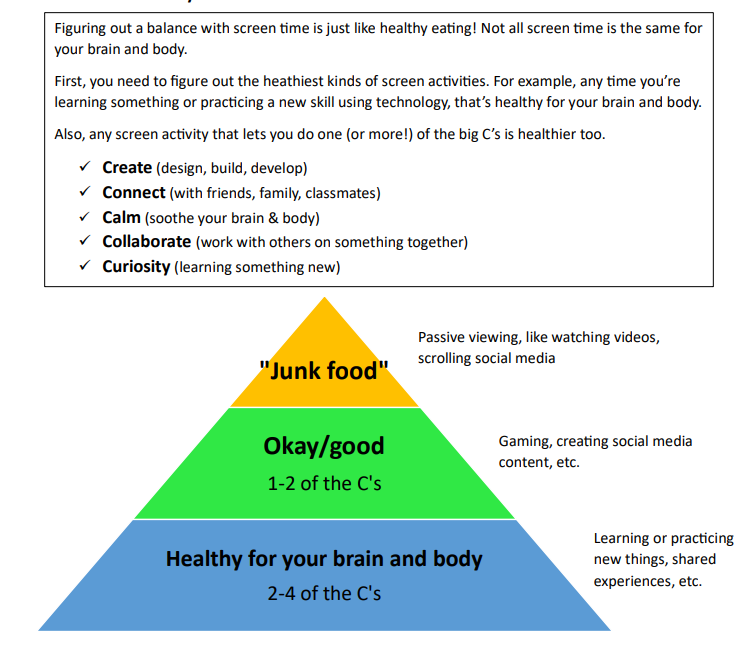
Together, create a list of all the things you use your screen for. As you make this list, think of how many of the big Cs (create, connect, calm, curiosity, collaborate, curiosity) are in each activity.
Match the screen activity to where it belongs on the pyramid.
For example:
Activity - playing Minecraft with a friend online
Curiosity, create, collaborate, connect
Activity - watching YouTube videos online
Calm (maybe?)
"It’s not how long we’re using screens that really matters; it’s how we’re using them and what’s happening in our brains in response"
-- Pediatrician Michael Rich, Centre on Media and Child's Health at Boston Children's Hospital (Ruder, D.B.)
Author
Taylor Nelson
Publish Date
September 18th, 2024
Keywords
Balance, Parenting, Screen Time, child development, digital diet,
Neurodevelopmental care for kids, youth & families
We offer creative therapeutic approaches to help navigate the tough stuff in childhood, parenting and adulting. Family Tree Therapy is a place where you can connect, imagine and belong.